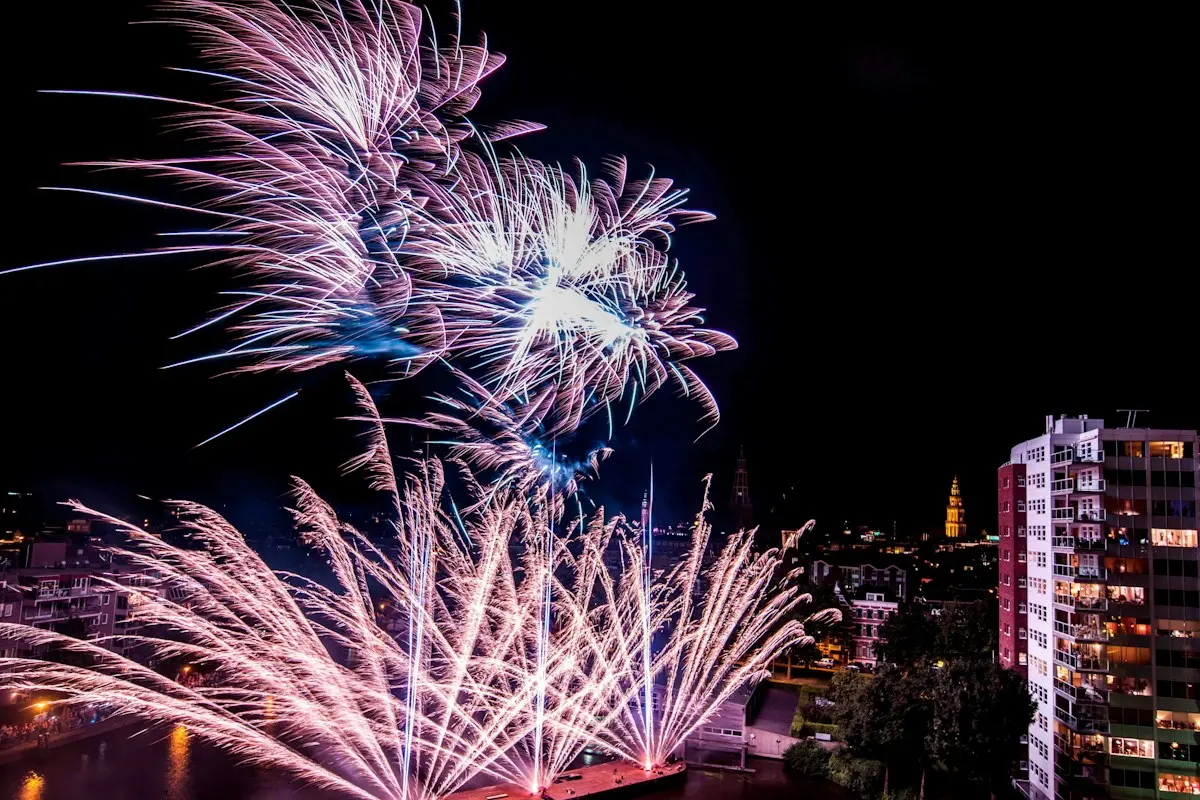
In just over five weeks it happens: the first Dutch New Year's Eve on which private individuals may no longer set off rockets and firework cakes. In the Netherlands, where lighting your own fireworks in the street at midnight was a tradition for generations, that is a real change. Many villages and neighbourhoods are asking the same question. If it no longer bangs in every street, who makes sure there is something to watch at midnight? Often people look to the neighbourhood association, the village hall or the football club.
This article sets out what an association or foundation can do, what is still feasible for this New Year and what you can already arrange for the next one.
What has applied since 1 August
The Safe New Year's Eve Act (Wet veilige jaarwisseling) entered into force on 1 August 2026. Since then consumers may no longer buy, possess or set off fireworks in categories F2, F3 and F4. Those are the rockets, cakes, compounds and bangers. Small category F1 fireworks, such as sparklers and party poppers, are allowed all year round.
Anyone who sets off fireworks anyway faces, according to the Dutch government, a fine of at least € 100 and a criminal record entry. The latter can cause trouble when applying for a certificate of conduct (VOG), which many Dutch employers and volunteer organisations ask for.
Professional fireworks displays remain possible all year round. Nothing changes there.
The exemption for associations and foundations
The act has one exception for non-professionals. The mayor can grant an exemption to an association or foundation with local ties that is listed in the trade register. As examples the government mentions a neighbourhood association or a sports club. An informal group of neighbours or a company falls outside it.
The conditions are stricter than most people expect. The main ones:
- Amount and type. Up to 200 kilos of category F2 display fireworks. No bangers.
- Time window. Only between 6 pm on 31 December and 2 am on 1 January.
- Distance to the audience. 15 metres for ground fireworks, 40 or 60 metres for aerial fireworks, depending on the calibre. These are the same distances professionals work with.
- Safety plan. The application includes a plan with a site drawing and a list of the fireworks. The site is outdoors, accessible to the emergency services and closed to the public beforehand.
- People. One or two supervisors and at most eight people lighting, all aged 18 or over, sober and wearing safety glasses. At least two fire extinguishers are on hand.
- Purchase. You collect the fireworks or have them delivered on 31 December between noon and 6 pm. The seller checks the exemption. Leftovers go back by 6 pm on 1 January.
There is no compulsory course, but the people lighting must know how to handle fireworks safely. Liability insurance is not required nationally; the mayor may demand it.
Allow for lead time. According to the government, a municipality needs at least eight weeks to assess an application.
Your municipality decides, and the outcome differs everywhere
The key word in the scheme is "can". The mayor may also decide to grant no exemptions at all, or to cap the number. That is happening widely:
- Delft grants no exemptions for this New Year and is trying out neighbourhood fire baskets instead.
- Opmeer and five neighbouring municipalities in West-Friesland grant none either, because they consider exceptions hard to enforce.
- Voorschoten refuses applications but organises a central, professional fireworks show itself.
- Tynaarlo, in the province of Drenthe, grants at most eighteen exemptions, no more than one per association, with a draw if several applications concern the same spot. The application window ran from 19 September to 19 October.
- Nieuwkoop allows one show per village. Applications closed on 1 September.
Whether you also need an event permit is determined by your municipality's general local by-law, the APV. The national decree explicitly leaves that to the municipal council.
What is still possible this New Year?
Frankly: for an exemption of your own you are too late almost everywhere. The windows in the municipalities that do grant exemptions have closed, and eight weeks of assessment no longer fits before 31 December.
A professional show is difficult at this notice too. For the so-called ignition consent (ontbrandingstoestemming), the province of Drenthe, for example, wants an application at least fourteen weeks in advance. Only smaller shows can be handled with a notification, no later than two weeks beforehand. That is a job for a licensed fireworks company. If you still want to try, call such a company and your municipality this week, and assume the answer may be no.
What is feasible:
- See what is already being organised. Your municipality's website shows whether there is a central show and which associations received an exemption. Joining an existing show is easier than starting one.
- Organise the evening without the fireworks. New Year's drinks in the village hall, a fire basket, oliebollen (the traditional Dutch doughnuts) and music need no exemption. Do check whether you have to notify the municipality of the event.
- Think carefully about alternatives. A drone show sounds like an easy replacement, but according to the Human Environment and Transport Inspectorate the operator needs an operating licence for it, plus a separate exemption to fly in the dark. That too is work for a specialist company, not something for the final weeks.
Know how many people are coming
One show for the whole village draws a bigger crowd than a street full of individual rockets ever did. That is exactly what the municipality looks at: does everyone fit behind the barrier, can the emergency services get through, and who keeps the overview?
It helps to know in advance how many people to expect. Free admission tickets do that: visitors reserve a place, you watch the number grow and you can set a maximum that suits your site. At the entrance you count who is in. A counted number is also the kind of evidence a municipality wants to see in a safety plan. How to set it up is described in our article on free events with ticketing.
Keep an eye on the weather as well. If unfavourable conditions are expected, the mayor must withdraw an exemption, preferably by 30 December. Make sure you can reach your visitors quickly, and that the rest of the evening is worth coming for without fireworks. More on weather in your event plan is in our piece on KNMI weather alerts in your safety plan.
Put next year in the diary now
If you do want a show on 31 December 2027, start in spring. A workable order:
- Read your municipality's policy rule. Search for "ontheffing vuurwerkverbod" and the name of your municipality. It states whether exemptions are granted, how many, and when to apply. Tynaarlo, for instance, will use 15 August to 30 September from next year.
- Check your legal form. Only an association or foundation registered with the Chamber of Commerce can apply.
- Find a site where the safety distances fit and that is not in or right next to a nature reserve. Some municipalities rule that out.
- Appoint your people and have them read up. The government has announced information material for those lighting the fireworks.
- Write the safety plan and ask your insurer for written confirmation.
- Apply on time, and allow at least eight weeks.
In closing
For many villages the first New Year under the ban will be an evening with fewer fireworks than hoped. That is less about unwillingness than about deadlines: the rules arrived in summer, the application windows fell in autumn. Read your municipality's policy rule now and you will be at the table in time next year.
Want to know in advance who is coming to your New Year's gathering or your show? With MijnEvent you create free admission tickets with a maximum number of places, and you pay no fee on free tickets for a public event. See our pricing or register your organisation. Signing up is free.